Integrating AI with Ramanomics and quantum science for label-free mapping of biochemical environment in live cells to advance cellular diagnosis and molecular medicine
Project website
Project Description
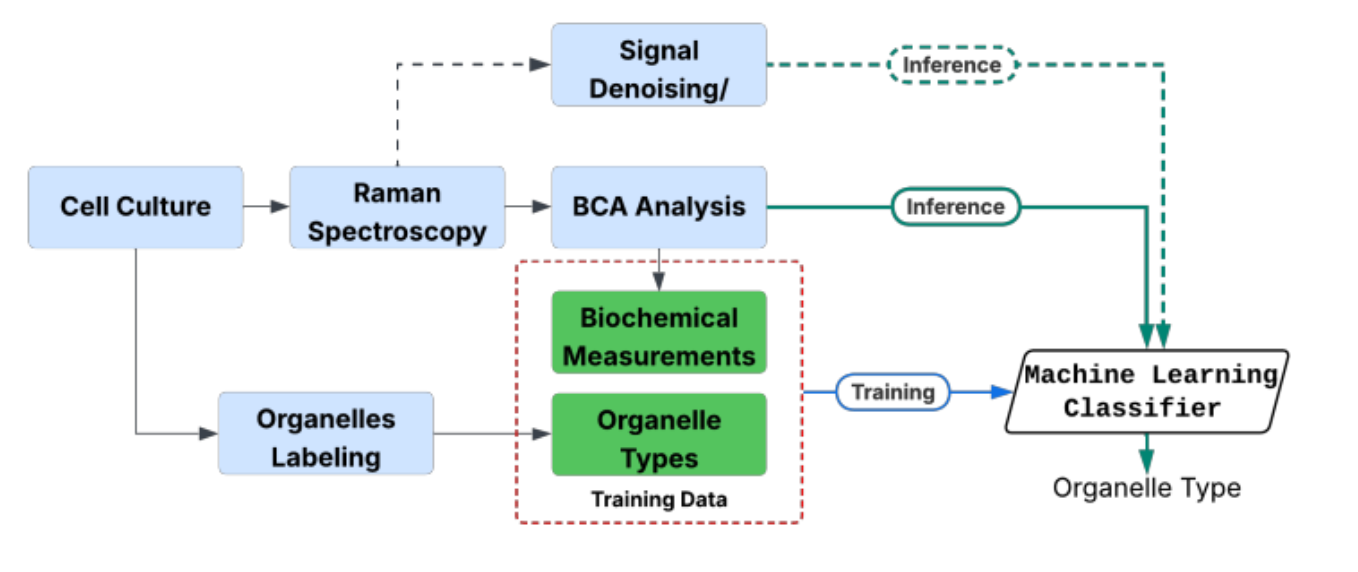
Raman spectrometry is a powerful technology enabling the mapping of the biochemical composition of (human) cells with submicron resolution. Its ability to obtain quantitative molecular information without the need for exogenous markers makes it uniquely suitable for monitoring molecular environment in single organelles. When integrated with Biomolecular Component Analysis (BCA) methodology, it provides the absolute concentrations of over a dozen of major subclasses of lipids, proteins and saccharides at the microscopic sites of spectra acquisition, thereby delivering an “Omics-like” power capable of detecting subtle biochemical changes in cells subjected to various diseases including cancer, metabolic dysfunction, or viral infection. Based on this strength of Raman spectrometry, we have spearheaded the development of optical Omics technology, coined Ramanomics1-3. A major advantage of this approach is its ability to bridge the gap between molecular profiling and live-cell imaging. The recent AFOSR DURIP award to acquire an integrated quantum-enhanced nonlinear imaging and sensing equipment will enable us to advance a new direction of Quantum Ramanomics, providing considerable gain in sensitivity and resolution to reveal more details of molecular changes as a function of disease progression and thus leading to molecular diagnostics and therapy. The outcomes of this project will allow us to position ourselves at the forefront of single cell biomolecular analysis – an area of research that is of vital significance for advancing life sciences, with an immediate impact on biomedical community eager to visualize and link the abnormalities of metabolic pathways with the origin and progression of a vast spectrum of disfunctions originating at the sub-cellular level.
UBDS Contributors
Tanvi Ranga (RA), Davoud Adinehloo (PostDoc) Varun Chandola (PI)
Other Contributors
Prof. Nalini Ratha, Prof. Paras Prasad, Prof. Vasili Perbeinos
Funding
University at Buffalo
Project Duration
12/2025 - 11/2027